Introduction:
Investing in the stock market is still one of the best ways to accumulate long-term wealth in the US, despite the fact that it can be daunting, particularly for novices. It is now easier than ever to enter the world of investing thanks to the growth of online brokerages, educational materials, and user-friendly trading apps. Understanding the fundamentals is a crucial first step, whether your goal is to increase your savings, get ready for retirement, or just learn how the market operates.
This article will walk total novices through the fundamental ideas and doable actions necessary to begin investing in the US stock market with confidence. You will discover how to approach investing with clarity and discipline, from selecting the best brokerage account to creating a diversified portfolio and avoiding typical pitfalls. You only need to be willing to take the first step toward financial independence; no prior financial knowledge is necessary.
What Is the Stock Market?
Investors purchase and sell shares of publicly traded companies on the stock market. In essence, you are purchasing a tiny portion of the business when you buy a share. Your shares may appreciate in value as the business expands and turns a profit, giving you the opportunity to profit from price increases or dividends.
Major exchanges like the New York Stock Exchange (NYSE) and the Nasdaq, where thousands of businesses list their shares, are how the US stock market functions. Through brokerage platforms, investors place buy or sell orders, and supply and demand determine how these trades are matched in real time.
The stock market is essential to the economy because it allows regular people to increase their wealth while assisting businesses in raising capital for growth. For novices, knowing how this marketplace operates is essential to making wise investment choices.

How to Start Investing in the Stock Market (Step-by-Step Guide)
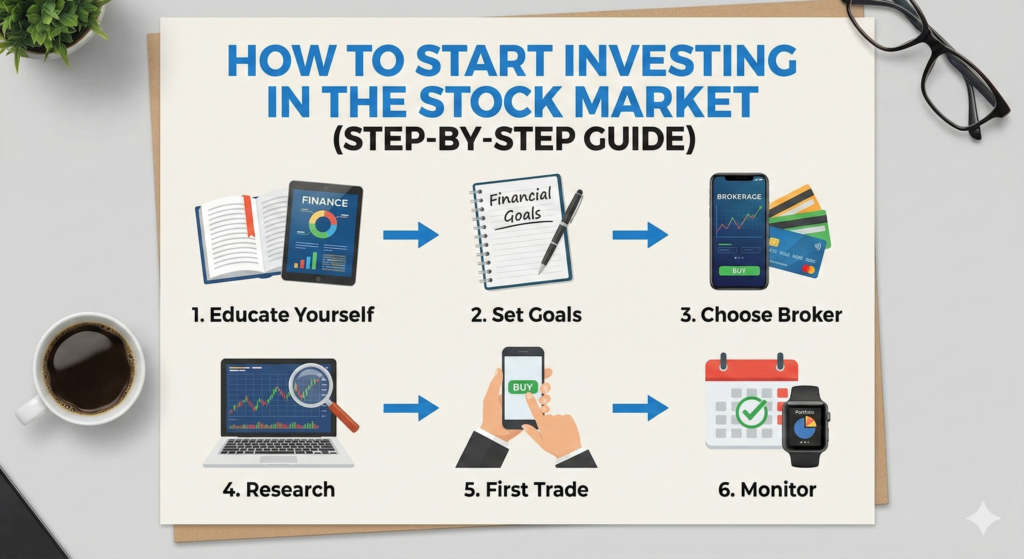
Step 1: Define Your Financial Goals
Knowing the purpose of what you are going to be investing in is important because it will help you create a plan based on your goals. A clear and concise financial goal will help guide your investment decisions and keep you focused in both good and bad market conditions and will also help you determine the best strategy for you.
The following are some examples of common financial goals:
Retirement: Investing as early as possible for retirement gives you the opportunity to benefit from the compounding of income that will take place over time. Don’t wait until you are older to start investing for retirement; investing early will allow you to invest less throughout your working career.
Accumulating Wealth: Investing in stocks, index funds, or ETFs gives you the opportunity to accumulate wealth much faster than you could by using traditional savings accounts.
Emergency Funds: While most people use the majority of their emergency funds in cash, some people invest a portion of their emergency fund into other long-term security and growth investments after establishing a cash emergency fund.
Child’s Education Fund: Many parents choose to invest in order to create a college savings fund for their children. Over time, these investments will typically provide significant growth and help pay for future tuition.
Step 2: Choose a U.S. Brokerage Account
To begin trading stocks in the stock market, you need a brokerage account to trade with. Online brokers (such as Charles Schwab) are a platform through which you can trade stocks, ETFs, mutual funds, and other securities. One of the first steps is choosing a suitable broker, as this will determine your fees, trading tools, and overall experience as an investor.
Some popular online brokers for beginners in the U.S. include the following:
Robinhood – known for being an easy-to-use platform with commission-free trades. Ideal for beginner investors looking for a simple platform to start.
Fidelity – provides investment research tools, commission-free trading, and excellent customer assistance. A good fit for long-term investors.
Charles Schwab – a good, trustworthy full-service broker with a low-cost structure, educational resources, and many different types of investment options.
TD Ameritrade has advanced trading tools and educational resources to help novice and veteran investors.
E*TRADE – a user-friendly mobile trading platform that allows traders to do many things with ease, and offers a variety of investment products.
Webull – designed for novice traders who want to learn about trading chart patterns, the implications of trading profit and loss (pips), and leveraging commission-free trading in conjunction with advanced charting capabilities.
Types of investment accounts:
It’s critical to select the appropriate account type for stock market investing based on your tax situation and financial objectives. These are the most popular choices:
Brokerage Account: An adaptable account that can be used by all kinds of investors. You can invest in stocks, mutual funds, ETFs, and more, and there are no contribution restrictions. Gains and dividends are subject to taxation in the year they are realized.
Ideal for long-term retirement savings is a Roth IRA. While qualified withdrawals are tax-free in retirement, contributions are made with after-tax money. Because of this, it is particularly advantageous if you anticipate a future increase in your tax rate.
Traditional IRA: You may be able to lower your taxable income in the year you invest by making tax-deductible contributions. It is a good choice if you wish to postpone taxes and possibly reduce your current tax burden because taxes are paid when you take money out during retirement.
Step 3: Understand Investment Options for Beginners
New investors often think they must pick individual stocks, but that’s not necessary.
After opening an investment account, the next thing to do is decide on which assets to invest in. If your new to investing you should start with lower risk, diversified and also relatively easy to manage….here are some of the most beginner friendly options.
Beginner-Friendly Investment Types:
Index Funds (example: S&P 500 Index Fund):
These funds invest in a market index (such asS&P 500) and will be diversified among many companies with no effort from you. They are typically less expensive than actively managed mutual funds because they do not require the same level of involvement as an active manager, and historically have produced consistent, long-term returns.
ETFs (Exchange Traded Funds):
ETFs are similar to index funds in that they also hold more than one stock or asset. However, you can buy them on the stock exchange like a single stock. This can give investors more choices, while still offering diversification within a single investment.
Blue Chip Stocks:
Large, well-established businesses that have a long track record of stable earnings and can be less fickle than smaller companies. These stocks can provide a conservative option to a beginner investor.
Dividend Paying Stocks:
For an investor looking to get regular income in the form of dividends and/or potential capital appreciation, dividend paying stocks offer this opportunity. For most passive investors and those investing for the long term, dividend paying stocks tend to be more appealing.
The Benefits of Index Funds for Beginners:
Index Funds Offer 3 Major Benefits:
Low Cost – index funds typically have the lowest operating expenses, so you will typically have less expense taken out of the return on your investment.
Diversification – index funds allow investors to diversify their portfolio by investing in many different companies at once.
Historically Profitable: Over the long term, index funds have consistently outperformed most actively managed funds.
Step 4 : Common Mistakes Beginners Should Avoid
Investing in the stock market can be exciting, but many new investors often fall victim to easily-avoidable mistakes that can hinder their long-term profits. In becoming successful as an investor, it is important to recognize and avoid common mistakes.
Here are some common investment mistakes to avoid:
Attempting to Get Rich Quick: Investing is a long-term endeavour; the majority of losses occur as a result of ‘chasing after the next hot stock’ or attempting to make fast money.
Getting information about what stock to buy from social media: Most social media stock tips lack reliability; always do your own research before investing your money.
Panic selling when the market goes down: It is natural for the market to experience volatility; instead of allowing these dips to eventually level themselves out, by selling out in a panic, you are only locking in a loss.
Investing funds that you will need in the immediate future: Only use money you do not need in the near future to invest. If you need to access your invested money soon, it may be necessary for you to sell your investment at a loss.
Failing to Diversify Your Portfolio: Investing all of your funds into one stock or one sector represents a high level of risk; attempting to invest across multiple sectors helps to smooth out the market fluctuation and to protect your investments from the downward spiral.
Key Takeaway:
Remaining calm, patient, and consistent is the single most important strategy for long-term investment success. Stay focused on your goals, stick to your plan and allow for time to build your wealth.
Step 5: Simple Beginner Portfolio Example (USA Stock Market)
It’s useful to see what a beginner-friendly portfolio might look like after you’ve selected your investments. A well-structured portfolio strikes a balance between risk management and growth potential, making it simpler for novice investors to begin with confidence.
Sample Low-Risk Beginner Portfolio:
- 70% S&P 500 Index Fund:
Provides broad exposure to 500 of the largest U.S. companies, offering diversification and long-term growth potential. - 20% Total Stock Market ETF:
Includes a wider range of U.S. companies, including mid- and small-cap stocks, for additional diversification. - 10% International Index Fund:
Adds global exposure, reducing reliance on the U.S. market and increasing portfolio stability.
For Even Lower Risk:
If you prefer a more conservative approach, consider adding:
- Bond ETFs:
Provide steady income and help protect your portfolio from stock market volatility. - Treasury Securities:
U.S. government bonds are low-risk, stable investments that can balance higher-risk equity holdings
Step 6: Is It Safe for Beginners to Invest in the U.S. Stock Market?
Yes—investing in the U.S. stock market can be safe for beginners when done correctly. The U.S. market is one of the most regulated and stable markets in the world, providing a transparent environment for investors.
What Beginners Should Keep in Mind:
- Short-Term Volatility is Normal:
Stock prices fluctuate daily. It’s important not to panic during market dips, as short-term swings are part of investing. - Long-Term Growth Potential:
Historically, the U.S. stock market has delivered strong returns over decades, making it a reliable option for long-term wealth building. - Use Safe Strategies:
Starting with diversified index funds, ETFs, or a mix of stocks and bonds helps reduce risk and provide consistent growth.
By focusing on long-term goals, diversification, and disciplined investing, beginners can safely grow their wealth while minimizing unnecessary risk
Conclusion: Start Investing Today for a Strong Financial Future
One of the best ways to increase your wealth over time is to invest in the stock market. Anyone can start building a solid financial foundation by establishing clear financial goals, selecting the appropriate accounts, beginning with investments that are accessible to beginners, and maintaining consistency.
Recall that patience, diversification, and disciplined investing are essential for success. The power of compounding allows even modest, regular contributions to increase dramatically over time.
Instead of waiting for the “ideal time,” begin investing now to start down the path to a safe and prosperous financial future.
FAQS
-
What is the minimum amount of money required to begin investing?
To start, you don’t need a lot. You can begin with as little as $50 to $100 with many brokers. Starting with a big amount is not as important as maintaining consistency over time.
-
Is it dangerous to invest in the stock market?
While there is some risk associated with all investments, long-term investments in index funds, ETFs, and diversified stocks have typically produced positive returns. Steer clear of investing funds that you might require in the near future.
-
What is the ideal investment for novices?
For novices, index funds and exchange-traded funds (ETFs) are typically the best choices. They are easier to manage than individual stocks because they are inexpensive, diversified, and historically dependable.
-
Is it possible for me to lose everything in the stock market?
Even though stock prices can decline, if you invest in reputable businesses or funds and diversify your portfolio, a total loss is unlikely. Steer clear of investing all of your money in risky assets or a single stock.
-
How frequently should I review my investments?
You don’t have to keep an eye on things every day. For long-term investors, reviewing your portfolio every quarter or every year is adequate. Refrain from making snap judgments based on transient market fluctuations.
https://shorturl.fm/Ko9L2