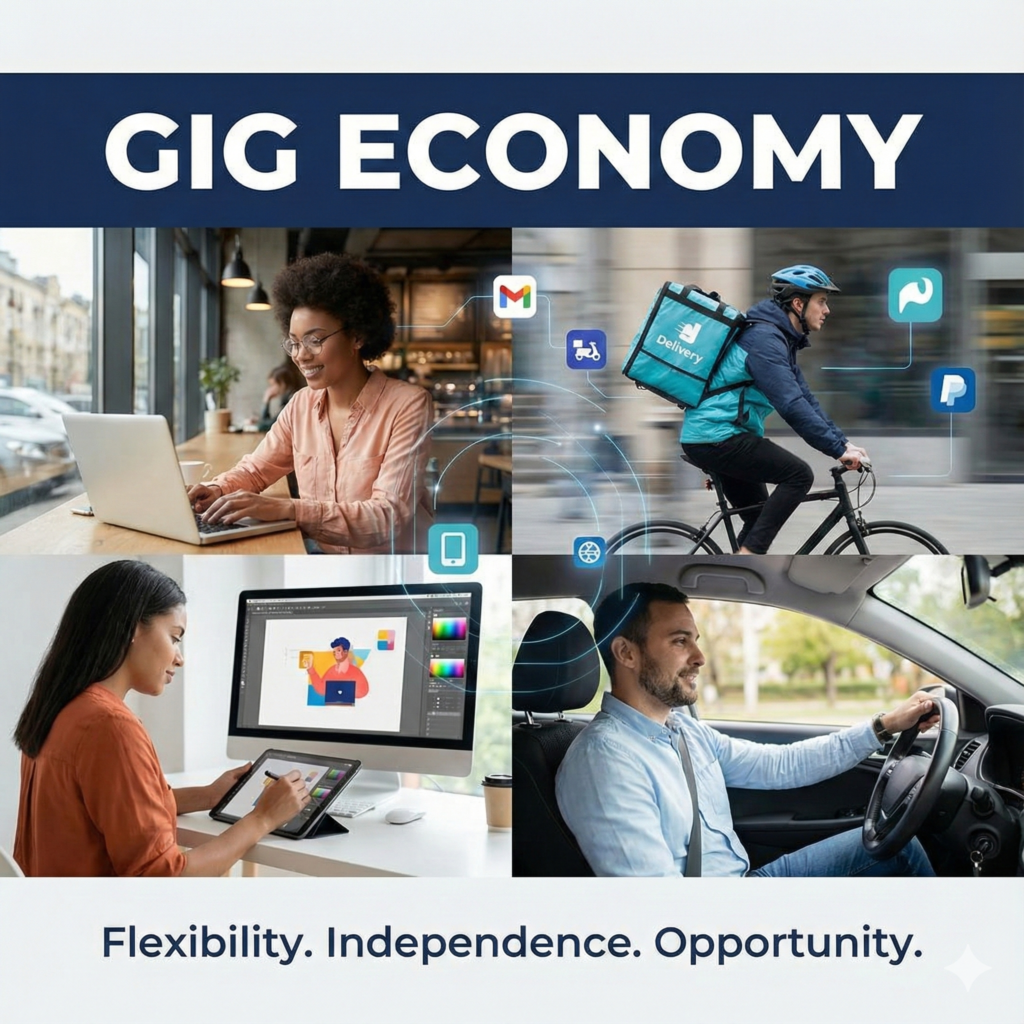


The bustling heart of the modern Gig Economy.
Introduction
In the US, the gig economy is changing how people work. Gig work, in contrast to traditional full-time employment, is made up of brief, flexible assignments that let people make money on their own terms. Thanks to technology and online platforms, gig opportunities are becoming more widely available, ranging from food delivery and ridesharing to freelance digital services.
The gig economy is more important than ever in today’s workforce. Instead of a traditional 9–5 schedule, many Americans are looking for flexible work arrangements, extra sources of income, or careers that fit their personal lifestyles. People can now take charge of their careers and work whenever and wherever they want, thanks to technological advancements and shifting work preferences.
The statistics show how popular gig work is: more than 36% of American workers currently engage in some kind of gig or freelance work. This expanding trend demonstrates how essential the gig economy has become to the contemporary labor market, offering chances for both work-life flexibility and financial independence.
What Is the Gig Economy?
Instead of working as regular full-time employees, people in the gig economy take on temporary, flexible jobs, frequently as independent contractors or freelancers. Usually task-based, this kind of work is mediated by technological platforms that establish real-time connections between employees and clients or customers.
Key characteristics of gig work include:
- Short-term assignments: Jobs are project- or task-based rather than long-term employment.
- Flexibility: Workers can often set their own schedules and choose when and how much to work.
- Task-focused: Compensation is tied directly to the work completed, such as a delivery, ride, or freelance project.
- Tech-driven: Most gig work is facilitated by apps or online platforms that handle job matching, payments, and sometimes ratings.
Difference from traditional employment:
Unlike traditional jobs that offer a fixed salary, benefits, and long-term job security, gig work provides independence and flexibility but usually lacks health insurance, retirement plans, or paid leave. While it offers more freedom, gig work also requires self-management and planning to ensure steady income.
The gig economy has become an attractive alternative for those seeking flexible work arrangements, supplemental income, or the freedom to control their professional lives, reflecting the evolving nature of today’s workforce.
Popular Gig Economy Jobs
The gig economy has continued to transform how individuals work to provide flexible means of earning to everyone who has time, abilities, or a smartphone. No matter what you want to switch to, full-time or a part-time side hustle, these are some of the most popular gig economy jobs that are taking the market by storm.

- Rideshare Driving The Uber and Lyft platforms have become the persona of the gig economy. Individuals can make some income by offering transport services using their cars. The employment has a high level of flexibility- work when demand is high and make more money out of surge pricing and bonuses.
- Food & Grocery Delivery Delivery apps became more popular, particularly with the increase in convenience-oriented life. The most popular platforms are DoorDash, Uber Eats, Instacart, and Postmates. The workers bring food, shop goods, or retail products, and many have the freedom of choice of when and where to work.
- Task-Based Services TaskRabbit offers individuals who are crafty, well-organized, or physically fit the chance to earn money assembling furniture, helping to move people, repairing their homes, and doing errands. Workers choose tasks and clients post them on their service that are appropriate to their skills and availability.
- Pet Care Services. Rover and Wag! are two websites that allow pet owners to generate revenue by utilizing their obsession. These are services that match the pet owners with sitters, walkers, and boarders. It is perfect when one wants to spend time with animals and make income on the terms of one or another schedule.
- New Gig Work (Online and Digital Work) Other than conventional gig jobs, there is an increase in new digital gigs.
These include: Freelance content development and writing. Animations and drawings of graphics. Virtual assistance, Social media management, Online tutoring, Website & app testing. The Fiverr, Upwork, and Freelancer platforms, among others, enable individuals worldwide to sell their services to customers, and in many cases, the individuals do not have to be professionally qualified.
Advantages of Gig Work
The gig economy has distorted the way people look at work, and benefits are more than traditional jobs can afford. Some of the main benefits that draw millions of employees to the opportunities offered by gigs include:
- Work Location and Flexible Schedule. Freedom is among the greatest attractions of gig work. Employees have the freedom of determining when and occasionally where they would like to work. This flexibility will serve the needs of students, parents, full-time workers who want to earn additional money, or any other individual who likes to control his/her everyday life.
- Low Barrier to Entry. The majority of gig jobs require low qualifications and skills. It could be the delivery of food, provision of freelance services, or even simple tasks, and since they do not have to have complex hiring procedures, they can start as quickly as possible. This has rendered gig work to many individuals.
- Short-term Earning Opportunities. Many gig platforms do not require workers to undergo long interviews and onboarding as opposed to traditional jobs, which might require several days or even several months. Once signed and approved, one is able to start working on tasks or orders in days or even hours.
- Capacity to Spread the Revenue Base. Gig work enables individuals to do away with a single employer. People can generate several income streams by doing other jobs, including rideshare driving, freelancing, and pet sitting. Such diversification ensures financial security and lessens the risks of losing a job.
Challenges of Gig Work
Gig work sounds great on the surface — it’s flexible, and you can jump in fast. But it’s not all smooth sailing. Gig workers face some tough challenges, and knowing what you’re up against makes it a lot easier to plan for the long haul.
First up: money. Gig work pays, but not always reliably. Some days you might rake it in, especially during busy hours. Other times, it’s a ghost town, and you’re left waiting for the next job. It’s hard to predict what you’ll make each week, so budgeting or saving for something big? That gets tricky fast.
Then there’s the benefits issue. Gig workers aren’t regular employees, so forget about health insurance, paid vacation, or sick days. No company retirement plan, either. If you get hurt or need time off, you’re on your own. Covering insurance or putting money aside for retirement falls on you, and that’s tough without steady pay.
Competition is another headache. Gig platforms keep growing, and more people are signing up all the time. Sometimes, there are way more workers than customers. That means more waiting around and lower rates, especially in crowded cities.
And don’t forget the legal stuff. Gig workers have to deal with their own taxes—self-employment taxes, keeping track of expenses, and filing estimated taxes every quarter. Laws around gig work keep changing, too. If you don’t stay on top of new rules and contracts, you could end up with nasty surprises at tax time or run into legal trouble.
Bottom line: gig work gives you freedom, but it also means extra responsibility. If you’re thinking about jumping in, it pays to know what you’re signing up for.
The Future of the Gig Economy
The gig economy is rapidly changing with new technology, changing expectations from workers on what they can expect to do as an independent contractor/gig worker, and new businesses’ demands for gig workers.
The evolution of technology continues to change how gig workers perform their responsibilities:
1. Technology influences how we connect with a gig worker. Technology continues to support gig workers via platforms and applications that are smarter, more efficient, and personalized.
Different developments influencing gig workers include:
AI in matching – With the growth of artificial intelligence, there are improved ways to connect workers to clients quicker and more accurately through analyses of the worker’s skill set, location, customer’s preferences, and available time.
Automation of administrative processes – With an ever-increasing amount of data generated through the gig economy, the scheduling, invoicing, payment, and performance tracking processes that are typically associated with gig work have been increasingly automated.
The Improved Way of Communicating and Interacting Between the Worker and Consumer – The development of tools such as text messaging, GPS tracking, and automated support services continues to enhance both the gig worker and consumer experience.
New Platforms for Specialized Gig Workers – Beyond the traditional gig roles of ride share and delivery, many new companies have come onto the market creating platforms specifically aimed at specialized skilled freelancers, such as designers, accountants, developers, and consultants.
As machine learning and automated processes continue to evolve and advance, it is anticipated that the tools available for gig workers will likewise evolve and allow gig workers to earn money more efficiently. specifically aimed at specialized skilled freelancers, such as designers, accountants, developers, and consultants. As machine learning and automated processes continue to evolve and advance, it is anticipated that the tools available for gig workers will likewise evolve and allow gig workers to earn money more efficiently. As an example of the emerging areas in the gig economy, below are a few examples of tech and digital service jobs that people will increasingly perform as independent gig workers.
2. Growth Sectors and Possible Developments
The gig economy continues to develop beyond the areas of traditional gig workers. The sectors that are expected to see continued development and growth and thus hold job growth potential are:
- Tech and digital services: Web development, UI/UX design, content creation, cybersecurity, AI-assisted tools, etc.
- Healthcare: Telemedicine assistants, Health Care Aides and Support Workers, Remote Medical Personnel and Consultants, etc.
- Education and tutoring: Online teaching, coaching by skills, Microlearning platforms, etc.
- Logistics and e-commerce support: Warehouse assistance, last-mile delivery, small business inventory management, etc.
- The Creative industries: Video editing, digital marketing, Social Media Management, and Virtual Production, etc.
With the continued development of the gig economy, this increase in the outsourcing of specialized tasks indicates that organizations of all sizes will continue to provide increased opportunities for gig workers in professional and high-wage careers.
3. The Emergence of Hybrid Work Models
As an emerging trend, hybrid careers are becoming more and more popular, where individuals combine their traditional jobs with gigs. By using this hybrid model, workers can benefit from the following:
- More diversified sources of income reduce financial risk
- Flexibility in terms of pursuing passion projects or working part-time on a freelance basis
- Skills development by working within the context of various industries
- A better balance between work and life due to a decrease in workload when needed
More companies are now looking to implement hybrid staffing models, where companies hire full-time employees for their core jobs and continue to utilize gig workers to meet their short-term, specialized, project-based work requirements. This allows companies to remain nimble while providing their workers with greater flexibility.
Conclusion
Gig work has changed the workforce landscape. With a growing number of companies and workers embracing the flexibility and accessibility that gig economy provides to replace traditional jobs, this trend is now a permanent fixture of our labor market. However, with these benefits also come possible negative side effects like fluctuation in wages, limited benefits for gig workers, and intense competition among gig workers.
As new technologies are developed, new types of gigs will be introduced that will create additional options for those who want to earn money doing what they love to do. Additionally, there will be increased use of hybrid work models, which will allow more workers to combine the advantages of traditional employment with those of freelancing and platform-based work arrangements, thereby improving work-life balance and security.
Ultimately, the future of the gig economy will depend on the adaptive abilities of workers, corporations, and governmental entities. For millions of workers, gig work will continue to be a strong source of financial flexibility and personal autonomy—especially in an ever-evolving, highly digitalised, increasingly automated, and rapidly changing work environment.
FAQs
What is the gig economy?
A gig economy consists of short-term (temporary) and flexible job opportunities (non-static). In most instances, gig workers are independent contractors (freelancers) that work for digital platforms
How is gig work different from traditional jobs?
Traditional jobs offer fixed salaries, benefits, and job security, while gig work offers flexible schedules but typically no benefits, no guaranteed income, and workers must manage their own taxes
What are the most popular gig economy jobs?
Common gig jobs include:
- Rideshare driving (Uber, Lyft)
- Food & grocery delivery (DoorDash, Instacart)
- Task-based jobs (TaskRabbit)
- Pet care (Rover, Wag!)
- Online freelance work (Fiverr, Upwork)
Who typically works in the gig economy?
Students, full-time workers seeking extra income, stay-at-home parents, retirees, and anyone looking for flexible, part-time, or independent work.